


The treatment of tungsten mine tailings has long faced three major challenges: high costs, low efficiency, and difficulty in recovery. On one hand, the tailings still contain considerable valuable tungsten minerals (such as black tungsten ore and white tungsten ore), which have reprocessing value. On the other hand, they are hard, have fine particle size distribution, and have complex gangue, and traditional crushing methods are prone to cause over-crushing and severe mudification, which not only increases the burden of ball milling but also reduces the recovery rate of gravity separation or flotation. Facing this predicament, more and more tungsten mining enterprises have begun to introduce hydraulic roller crushers as the core equipment for tailings pre-treatment. Through the “accurate crushing, particle shape optimization, and energy saving and consumption reduction” triple paths, the economic efficiency of reprocessing has been significantly improved. So, how does the hydraulic roller crusher achieve increased production and reduced consumption?
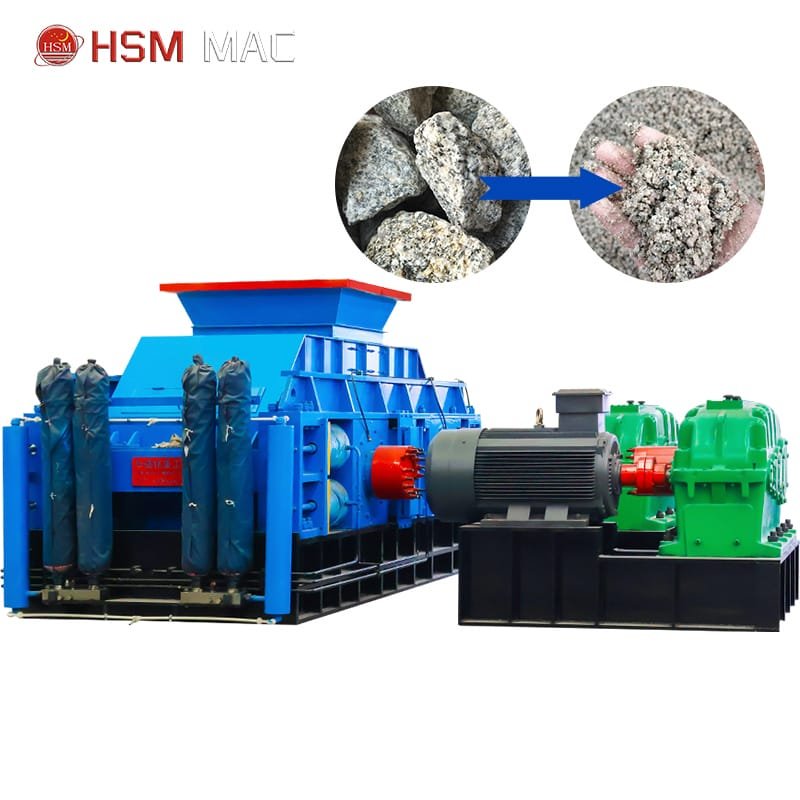
I. why do the traditional crushing methods “hold us back”? Most of the reprocessing lines for tungsten mine tailings still use old-fashioned hammer crushers or impact crushers for fine grinding. These devices rely on high-speed impact forces to break down the materials. However, when dealing with tailings with high silicon and high hardness, they have fatal flaws: Excessive crushing severity: A large amount of useful minerals are crushed into <0.074mm fine powder, which enters the sludge system and is difficult to be recovered, directly resulting in metal loss; Inconsistent particle size: The discharged material contains both large chunks (>10mm) and fine powder, resulting in the ball mill being unable to effectively grind the large chunks and over-grinding the small ones, leading to low productivity. High energy consumption and rapid wear: The hammer head is scrapped within a few weeks under the influence of hard quartz and garnet. Frequent shutdowns for replacement are required, and the actual production capacity is far lower than the designed value. The result is: The power consumption of ball grinding remains high, the consumption of steel balls is large, the recovery rate of concentrate is stagnant, and the overall processing cost is difficult to decrease.
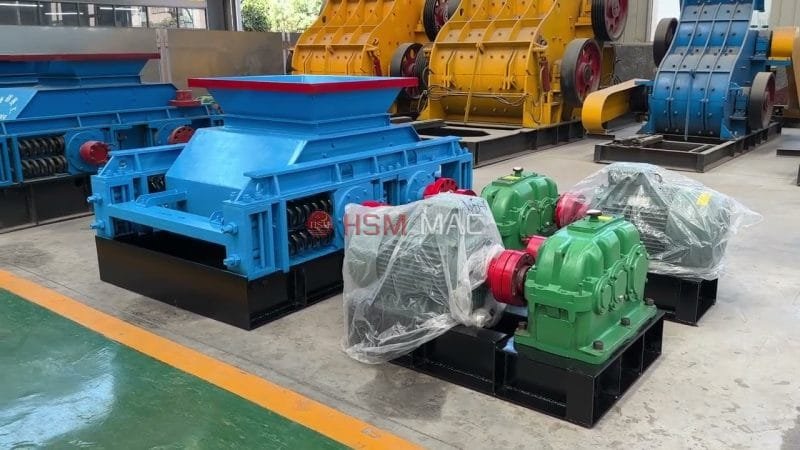
Stone Crusher Machine
II. Hydraulic Roll Press: Reconstructing Crushing Logic through “Static Pressure Lamination” The hydraulic roller crusher adopts the principle of high-pressure static compression laminating – the material is subjected to controlled pressure between two high-strength alloy rollers, and then decomposes along the internal cleavage plane. This “gentle yet highly efficient” crushing method fundamentally resolves the drawbacks of traditional equipment:
1. Low crushing rate, protecting valuable minerals Due to the absence of high-speed impact, the energy of the fragmentation process is concentrated on the effective cracking process. The generation rate of -0.074mm fine powder is usually less than 5%, significantly reducing the clayification of tungsten minerals. This retains more recoverable coarse particles for subsequent reprocessing (such as shaking tables, spiral classifiers), and the recovery rate of the concentrate generally increases by 5-10 percentage points.
2. The discharged particle size is uniform, and the grinding conditions are optimized. The equipment can crush the tailings into a stable size of 1–3mm or 3–8mm (adjustable according to process requirements), with a narrow particle size distribution and continuous gradation. The ball mill “eats” uniform fine materials, no longer requiring a large amount of energy to crush large pieces. The hourly processing capacity increases by 20%–35%, while the wear of the steel balls is reduced.
3. Significantly reduce system energy consumption “More breaking and less grinding” is the core principle of energy conservation in mineral processing. The unit power consumption of the hydraulic roller crusher is much lower than that of hammer crushing, and due to the finer feed particle size, the power consumption of the ball mill can be reduced by 25% to 40%. Taking a production line that processes 300,000 tons of tailings per year as an example, just in terms of electricity costs, the annual savings can reach several million yuan.
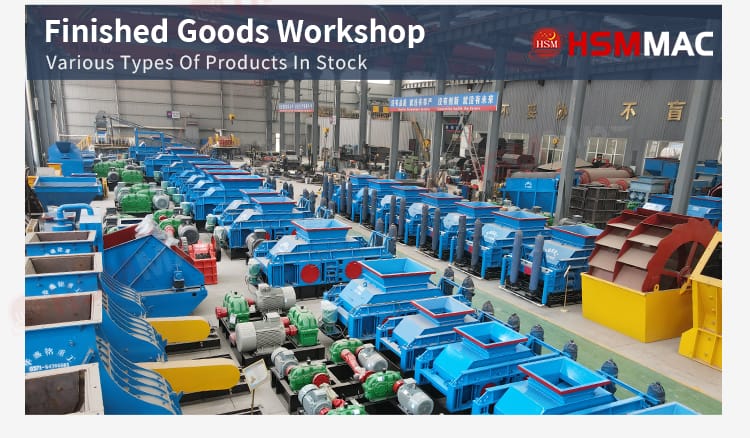
III. Wear-resistant and reliable, ensuring long-term low-cost operation The tailings from tungsten mines often contain strong abrasive minerals such as quartz, feldspar, and pyroxene, which cause severe wear to the equipment. To address this situation, professional manufacturers like Huashengming have developed high-chromium-manganese steel integral cast rolls or tungsten carbide hard alloy surface welding rolls. The surface hardness reaches above HRA86, and the roll life can last for 2-3 years, eliminating the high maintenance costs associated with “monthly parts replacement”. The entire machine is equipped with heavy-duty frames, thin oil lubrication, and multiple seals to ensure stable operation in dusty and humid environments.

IV. Real Case: From “Loss Handling” to “Profit Recovery” In a certain tungsten mine in Jiangxi Province, the tailings reservoir has accumulated over one million tons. Originally, it was planned to only use it for backfilling. Later, a hydraulic roller crusher and a heavy separation process were introduced. The tailings were crushed to 2mm and then sent to a shaking table, with the tungsten recovery rate reaching over 65%. The annual added value of the refined ore exceeded 10 million yuan. More importantly, the cost per ton of tailings treatment decreased by 30%, truly achieving the transformation of waste into treasure. Similar cases keep emerging in places like Hunan and Yunnan. Users generally report: “Previously, tailings were a burden; now they are a resource. Previously, crushing was a bottleneck; now it is an efficiency-enhancing point.”

equipment of hydraulic roller crusher
V. Implementation Suggestions: Scientific Allocation To fully utilize the efficiency of the hydraulic roller crusher, the following suggestions are recommended: Front-end screening and impurity removal: Remove foreign objects such as wood chips and ironware to protect the roller surface; Granularity accurate matching: Based on the particle size distribution of the tungsten minerals, the discharge is optimized (typically 1–3mm is suitable for gravity separation); Intelligent linkage control: Forming a closed loop with the feeder and the ball mill, achieving full-process collaboration; Select dedicated manufacturers: Give priority to those original manufacturers that have practical experience in tungsten mining and can provide wear-resistant solutions and technical support. The tailings from tungsten mines are not “waste”, but “awaiting-revitalized resources”. The processing cost is high, and the root cause does not lie in the tailings themselves, but in the outdated crushing method.
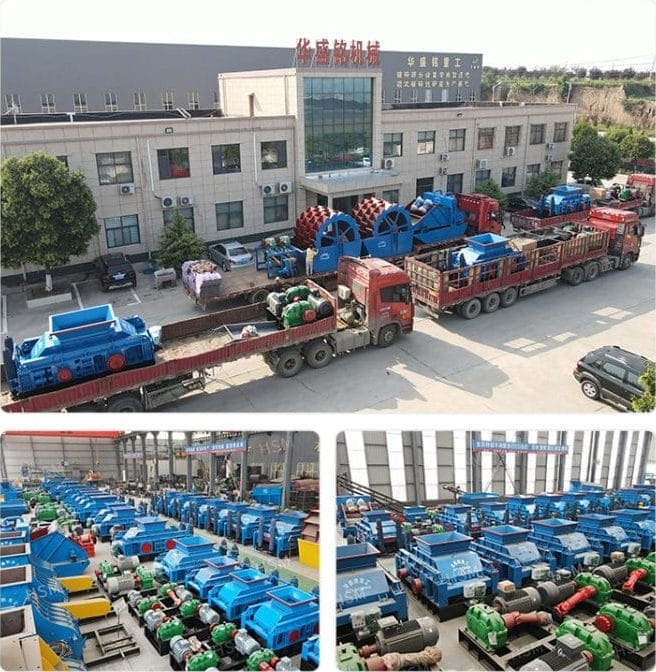
Double Roll Crusher
The hydraulic roller crusher, with its four advantages of “low over-crushing, high yield rate, low energy consumption, and long lifespan”, injects new vitality into the re-selection of tailings. It is not only a crushing equipment, but also a bridge connecting “resource conservation” and “economic benefits”. For tungsten mining enterprises that aspire to reduce costs and increase efficiency and practice the concept of green mines, introducing the hydraulic roller crusher might be that crucial “miracle transformation” move.