


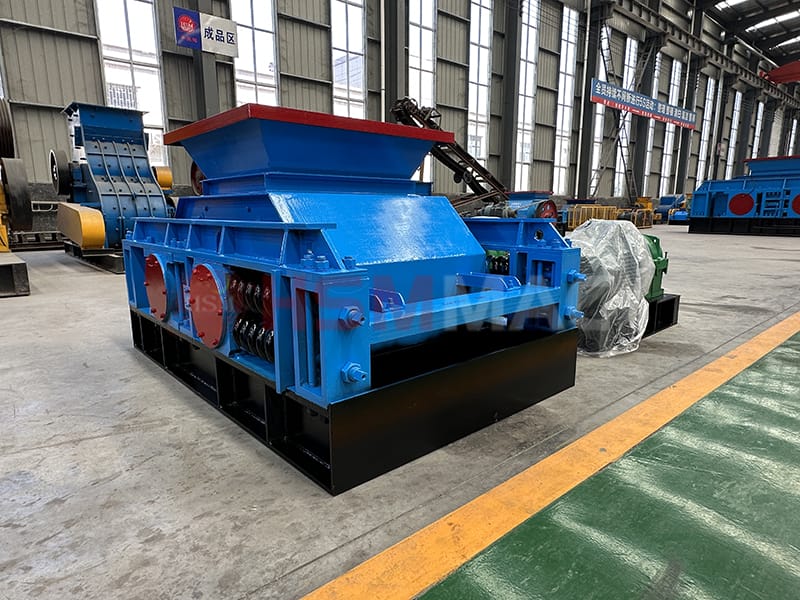
A double-toothed roll crusher is a type of crushing equipment that utilizes two counter-rotating toothed rolls to split, shear. And compress materials for size reduction. It primarily consists of core components like the motor, reducer, toothed rolls, and frame. Known for its compact structure, low over-crushing rate, and uniform product size, it is widely used for crushing materials of medium hardness and below in industries such as coal, metallurgy, chemical engineering, and building materials.
Double-Toothed Roll Crusher: Principles, Advantages, and Applications Analysis
Its working principle is as follows: material is fed from above into the gap between the two rolls. Driven by friction and gravity, it enters the crushing chamber. The two toothed rolls rotate toward each other, utilizing the splitting, shearing. And compressing action of the teeth to break the material. The final product size is primarily determined by the gap (discharge opening) between the rolls, which can be adjusted to control the output size and meet different process requirements.
Compared to other types of crushers, the double-toothed roll crusher offers significant advantages. Its energy consumption is relatively low, it generates less fine powder, and the final product has a favorable particle shape. The equipment operates relatively smoothly with lower noise and vibration, and maintenance is more convenient. Particularly in the coal industry, for the primary and secondary crushing of raw coal or coke, it effectively avoids over-crushing, improving the lump coal rate in saleable coal and delivering notable economic benefits. However, it is generally not suitable for crushing very hard or highly abrasive materials.
In summary, the double-toothed roll crusher is a highly efficient and reliable key piece of equipment in mineral processing, coal preparation, and raw material preparation flowsheets. Its excellent crushing characteristics make it irreplaceable in specific material processing applications.