

Direct Answer: Yes. Smooth double roll crushers are exceptionally well suited for manufactured sand production. Operating as fine crushing equipment, they utilize low-speed interparticle compression to yield low over-grinding, controllable stone powder content, and minimal maintenance costs. While they cannot handle large raw boulders directly without primary and secondary pre-crushing, pairing a double roll crusher with a vibrating screen in a closed-circuit loop delivers high-efficiency 0–5 mm construction sand. 📏 Output Fineness: How Fine Can It Produce? The achievable particle size depends directly on the adjustment mechanism (hydraulic vs. mechanical spring) and roller shell configuration: Equipment Type Minimum Roller Gap Output Fineness & Application Scenarios Hydraulic Smooth Double Roll Crusher (Recommended for Sand Making) 0.5 mm Finest finished sand reaches 0.5–1 mm under optimal conditions; standard output is 0–5 mm construction sand. Ideal for pebbles, granite, and quartzite. Spring Smooth Double Roll Crusher 1.0 mm Stable minimum output size is 1 mm, typically producing 1–5 mm sand. Best suited for small and medium sand plants. Toothed Roll Crusher Varies by tooth profile Designed for coarse aggregate crushing and material de-agglomeration—not suitable for fine sand production (<5 mm). ⚠️ Operational Tip: Actual discharge size is slightly larger than the physical roller…

Q: Which ores and rocks are suitable for double-roll crushers? Which materials cannot be processed? A: Huashengming double-roll crushers operate via counter-rotating inter-particle compression, making them ideal for brittle, medium-to-high hardness materials in secondary and fine crushing stages. Conversely, plastic, high-toughness, or sticky materials are unsuitable for this mechanism. ✅ Recommended Feed Materials 1. Hard Rocks & Aggregates (Top Choice for Sand Making) River pebbles, cobbles, granite, basalt, diabase, quartz stone, bluestone, limestone, calcite, marble, weathered rock, and aggregate recirculation oversize (grit/rice stone returns). Process Note: Hydraulic models paired with high-wear alloy shells deliver cubical particle shapes with low fines and minimal flaky fragments, making them ideal for processing returned material from VSI impactors. 2. Metallic & Non-Metallic Ores Iron ore, gold ore, copper ore, manganese, lead-zinc ore, phosphate rock, barite, and other brittle ores. Used in fine crushing within mineral processing to achieve “More Crushing, Less Grinding” and reduce downstream ball mill loads. 3. Industrial Raw Materials & Solid Waste Coal, coke, granulated blast furnace slag, steel slag, cement clinker, concrete rubble, brick fragments, and construction waste pre-treatment for metallurgy, brick making, and recycling plants. ⚠️ Material Constraints & Strict Prohibitions ⚠️ Use with Caution (Requires Controlled Conditions) Sticky,…
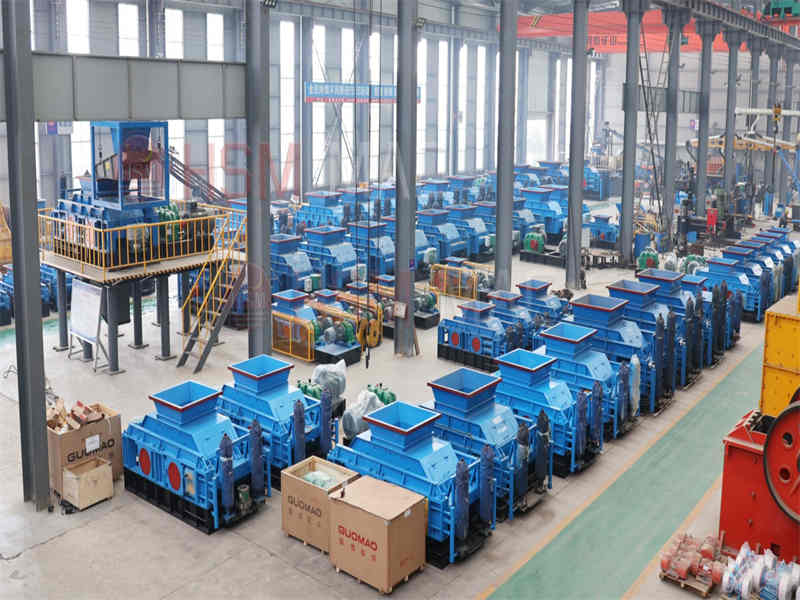
How to Select the Right Model for a Double-Roll Crusher Overview: Selecting the proper double-roll crusher model depends on 5 core factors: material type and hardness, maximum feed stone size, required discharge particle size, hourly output, and system configuration (smooth-roll vs. toothed-roll, spring vs. hydraulic). 🏷️ Decoding Model Names (e.g., 2PGY-1000×800) 2PG: Double-roll crusher Y / T: Adjustment system (Y = Hydraulic type; T = Spring type) 1000: Roller shell diameter in mm (determines maximum feed size) 800: Roller shell width in mm (determines production capacity) Figure 1: Smooth-roll for fine sand-making vs. Toothed-roll for coarse primary crushing Step 1: Confirm Roller Surface Type & Mechanism ① Smooth-Roll Crusher (2PGT / 2PGY) The preferred choice for manufactured sand and small aggregate (discharge size 1–20 mm) using quartz stone, cobblestone, weathered sand, and granite. Spring-Type (2PGT): Low-cost solution best suited for small-scale operations and low-abrasion materials. Hydraulic-Type (2PGY): Mainstream option for industrial sand-and-gravel production lines. Features automatic yielding protection with pressure relief for tramp iron/uncrushable objects, extending roller shell service life. ⚠️ Note: Smooth rolls have weak material-biting capacity. Oversized raw stones must be pre-crushed by an upstream jaw crusher. ② Toothed-Roll Crusher Designed for primary crushing of large-size feed materials…

Jaw crushers and roll crushers are both compression-type crushing equipment widely used in mining, building materials, metallurgy, and other industries. However, they differ significantly in application scope, working principles, and product output. Working Principle Jaw Crusher uses the periodic approaching and retreating motion between the movable jaw and fixed jaw to crush material. The motor drives the eccentric shaft to move the movable jaw up and down. When the movable jaw approaches the fixed jaw, material is crushed by compression, splitting, and bending forces. When it retreats, the crushed material is discharged from the bottom. The jaw crusher operates intermittently, with crushing and discharging alternating. Roll Crusher uses two counter-rotating rolls to apply continuous compressive and shearing forces to the material. Material falls into the V-shaped crushing chamber between the rolls, is drawn into the roll gap by friction, and is discharged from the bottom after compression crushing. Application Scenarios Jaw Crusher is mainly used for primary and secondary crushing, with feed sizes up to 1200mm or more. It offers high processing capacity and is suitable for primary crushing of various hard ores and rocks. Large jaw crushers have feed openings over 600mm, while medium-sized units range from 300-600mm. Roll Crusher is mainly used for secondary…

Q1: Are roll crushers and classifiers the same type of equipment? No. Although they often appear on the same production line, their functions and positions are completely different: roll crushers are for “crushing,” while classifiers are for “separating.” A roll crusher is a crushing device that uses two counter-rotating rollers to apply squeezing and shearing forces to materials, breaking them down before discharge. Depending on the roller surface, they can be divided into smooth rollers and toothed rollers. Classifiers, however, have two different meanings that need to be distinguished: Type 1: Spiral Classifier (commonly used in mineral processing). This equipment classifies materials based on the different settling velocities of particles in water. Fine particles remain suspended in the water and are discharged with the overflow, while coarse particles sink to the bottom of the tank and are pushed back to the ball mill by the spiral for further grinding. It is often used in closed-circuit with ball mills. Type 2: Sizing Crusher (Hua Sheng Ming’s core product). This is a crushing device that integrates both crushing and classification functions, but it is essentially a crusher, not a classifier. Particles smaller than the discharge size pass through directly without being crushed, while only larger materials are…

Q: What is the main purpose of a roll crusher? Roll crushers are widely used in mining, building materials, chemical, and metallurgical industries, primarily for medium and fine crushing of materials with medium hardness and below. Common materials include limestone, slag, coke, coal, mineral slag, cement clinker, and more. Q: How does a roll crusher work? A roll crusher consists of two counter-rotating rollers. Material falls into the gap between the two rollers and is crushed by compression, shearing, and grinding forces, then discharged from the bottom of the machine frame. Q: What are the key advantages of a roll crusher? Simple structure, easy maintenance: Compact design, few wear parts, and low routine maintenance workload. Uniform output, low over-crushing rate: Material passes through the rollers only once, minimizing over-crushing and ensuring consistent product size. Adjustable output size: The gap between rollers can be easily adjusted via wedge or shim devices to control product size. Reliable overload protection: When unbreakable objects enter, the movable roller automatically retracts to discharge the foreign object, protecting the equipment from damage. Q: What makes Huashengming roll crushers special? Huashengming specializes in R&D and manufacturing of roll crushers and roll sand makers, with over 20 national…

Q1: How does a rotary crusher work? A rotary crusher uses the mechanical energy of rotating components to apply compressive, shearing, or impact forces to materials, breaking them down to the target particle size. It mainly includes three types: Roll Crusher, Toothed Roll Crusher, and High-Pressure Grinding Roll (HPGR). All three control output particle size by adjusting the roll gap, offering easy operation and high precision. Q2: What equipment does a rotary crusher include? “Rotary crusher” is a general term covering various types of equipment that use rotating components (such as rolls or rotors) to crush materials. In mining, building materials, and solid waste processing, the main types include: 1. Roll Crusher Composed of two counter-rotating rolls. Material is fed into the gap between the rolls and crushed by compression and shearing forces. Output size is controlled by adjusting the roll gap. Features low over-crushing rate and uniform particles. Widely used for medium and fine crushing of limestone, slag, coal, and other materials. 2. Toothed Roll Crusher The roll surface is equipped with crushing teeth that bite into the material and apply tearing and splitting forces to break large chunks into smaller pieces. High crushing efficiency, suitable for coarse crushing of…

Q: How Does a Double Roll Crusher Work? A double roll crusher works by using two counter-rotating rollers to crush, shear, and grind materials into the desired particle size through compression. Q1: What is the basic working process of a double roll crusher? Material enters the crushing chamber from the top hopper and falls between two rollers. Due to the friction of the roller surfaces and gravity, the material is drawn into the “V-shaped crushing zone.” Under powerful compression and shearing forces, the material is crushed into smaller pieces and discharged from the gap between the two rollers at the bottom. Q2: How is the output particle size controlled? The output particle size is determined by the gap between the two rollers. Huashengming double roll crusher allows flexible adjustment of the roll gap through spring or hydraulic systems, with output size controllable between 0.5-20mm. Q3: What happens when encountering hard objects or tramp iron? The double roll crusher is equipped with an overload protection system. When unbreakable objects (such as tramp iron) enter the crushing chamber, the movable roller automatically retracts via hydraulic cylinders or spring action to increase the gap, allowing the object to pass safely, then quickly resets – protecting…
Q1: How much can the power plant slag roll crusher produce? Huashengming power plant slag roll crusher (also known as water-quenched alkaline cupola slag crusher) covers a full range of capacities from 2 to 400 tons per hour. The exact capacity depends on the selected model, with solutions available for small, medium, and large projects. Q2: What are the specific capacities of different models? Models are available in small, medium, and large sizes: Small Spring Roll Crushers Models: 2PGT400×250, 2PGT400×400, 2PGT610×400 Capacity: 2–20 t/h Applications: Small to medium slag processing projects Medium Spring Roll Crushers Models: 2PGT750×500, 2PGT800×800 Capacity: 20–50 t/h Applications: Medium-scale slag processing projects Medium Hydraulic Roll Crushers Models: 2PGY750×500, 2PGY800×600, 2PGY800×800, 2PGY1000×800 Capacity: 20–80 t/h Applications: Medium-scale projects; hydraulic models offer smarter control, higher output, and greater cost efficiency Large Flagship CNC Hydraulic Roll Crushers Models: 2PGY1000×1000, 2PGY1200×1000, 2PGY1200×1200, 2PGY1500×1000, 2PGY1800×1000, 2PGY2000×1000 Capacity: 80–400 t/h Applications: Large slag processing projects; one-touch start/stop for convenient operation Q3: What are the feed size requirements? The feed size range is typically 25–100mm, varying by model. Smaller models generally accept feed sizes around 40mm, while larger models can handle up to 120mm or even 150mm. The slag roll crusher is suitable for…

Q: What exactly is the processing capacity (output) of a double roll crusher? A:Hello! The processing capacity of a double roll crusher (also known as a roll crusher) is not a fixed value. It varies depending on the equipment model, roller dimensions, and the characteristics of the material being processed. Generally speaking, the processing capacity of double roll crushers manufactured by Huashengming Heavy Industry spans a very wide range, from 2 tons per hour (tph) to 400 tph, fully meeting the needs of production lines of various scales. They can be categorized into the following tiers: 1. Small Double Roll Crushers (2 – 50 tph) Common Models: 2PGT400×250, 2PGT400×400, 2PGT610×400, etc. Application Scenarios: Ideal for small sand and gravel plants, laboratories, small brick factories, or startups with limited budgets. 2. Medium Double Roll Crushers (30 – 100 tph) Common Models: 2PGY800×600, 2PGY800×800, 2PGY1000×800, etc. Application Scenarios: Suitable for most small and medium-sized mines, manufactured sand production lines, and coal preparation plants. These are the mainstream models in the market. 3. Large Fully Hydraulic Double Roll Crushers (100 – 400+ tph) Common Models: 2PGY1200×1000, 2PGY1500×1200, 2PGY2000×1200, etc. Application Scenarios: Specifically designed for large quarries, large building material plants, and national infrastructure projects, featuring powerful continuous operation capabilities. 💡…
Q: What is the processing capacity of Huashengming roll crushers? How many tons can the equipment produce per hour? A: Huashengming roll crushing equipment is mainly divided into three categories: smooth double roll crusher, double toothed roll crusher, and high-pressure grinding roll. The three models differ greatly in structure, working conditions and hourly output. Below are their accurate production capacities and applicable scenarios. 1. Smooth Double Roll Crusher (Dry Material Fine Crushing) Hourly Capacity: 20–400 t/h Small models achieve 20–80 t/h, suitable for laboratory use, small mineral processing and small-batch fine crushing of dry mortar materials. Medium models reach 80–200 t/h, mainly used for processing river pebbles, calcite, quartz stone, marble, cobblestone and bentonite. Large full-hydraulic smooth roll models can reach 200–400 t/h. Adopting static pressure extrusion crushing, this equipment features low over-crushing rate and uniform particle size. It is specially designed for dry and hard ores and construction aggregate production lines, perfectly matching the “more crushing, less grinding” process in the front-end of ball mills. 2. Double Toothed Roll Crusher (Wet & Viscous Material Crushing) Hourly Capacity: 7–300 t/h Featuring large crushing ratio and strong material grabbing capacity, small models deliver 7–60 t/h, ideal for fine crushing construction waste,…

Q: How to choose a gold ore crusher with a capacity of 300 tons per hour? A: A gold processing plant with a capacity of 300 t/h typically adopts a three-stage crushing process: jaw crusher for primary crushing, cone crusher for secondary crushing, and fine crushing. The fine crushing stage is the key, as it directly determines the feed size for the ball mill, affecting grinding efficiency and recovery rate. For fine crushing, we recommend the roll crusher. Huashengming roll crusher uses double‑roll static compression, with output size controllable to 3‑8mm. It generates less over‑crushing, minimizes gold particle loss, features wear‑resistant roll shells, and has low maintenance costs – making it more suitable for gold ore fine crushing applications. For a 300 t/h requirement, we suggest a jaw crusher for primary, a cone crusher for secondary, and a Huashengming large hydraulic roll crusher for fine crushing – delivering stable output and controllable operating costs. If you have specific parameters such as ore hardness and moisture content, please contact the Huashengming team for a customized selection proposal.↓




 +86-13838144666
+86-13838144666
+86-13838144666


