

Frequently Asked Questions Q1: What materials are HSM Roller Crushers best suited for? Our roller crushers excel at processing medium to high-hardness materials (up to 300Mpa), including granite, basalt, river pebbles, quartz, coal gangue, and iron ore. They are the ideal choice for minimizing over-crushing in sand-making lines. Q2: How long do the roller skins last? Thanks to our proprietary alloy casting process, HSM roller skins typically last between 1 to 3 years depending on the abrasiveness of the material and daily operation hours. This is significantly longer than standard manganese steel rollers. Q3: Can I adjust the output particle size? Yes. For Spring models, it’s adjusted manually via bolts. For Hydraulic models, you can adjust the gap settings in seconds via the control panel or smartphone (if equipped with the Intelligent System), achieving precise sizes from 1mm to 20mm. Q4: Is the equipment difficult to maintain? Not at all. HSM crushers feature a simplified mechanical structure. With our central lubrication system and easy-access design, daily checks take less than 15 minutes. We also provide full video guidance for parts replacement. Q5: Do you support customized voltage for international markets? Absolutely. We customize motors and electrical cabinets to meet your…

Mobile Roller Crusher: Expert Q&A Everything you need to know about HSM’s flexible crushing solutions for site-to-site operations. Q1: How much time does it take to move the crusher from one site to another? A: This is the greatest advantage of the Mobile Roller Crusher. Because the feeder, crusher, and screen are integrated on a single chassis, there is zero foundation work required. You can typically fold the conveyors, hitch it to a trailer, and be on the road in less than 2 hours. Once it arrives at the new site, it can be operational the same day. Q2: How do I power the mobile crusher in remote areas without a power grid? A: We offer flexible power options. Our mobile crushing stations can be configured with an on-board diesel generator set. This allows the machine to work completely off-grid in remote mining or construction sites. For areas with electricity, a standard dual-power system is available to switch between the grid and the generator. Q3: Is the mobile version as stable as a fixed roller crusher? A: Absolutely. Our mobile chassis is built with heavy-duty U-beam steel and equipped with multiple hydraulic or mechanical support legs. These legs lift the…

Roll Mill Crusher: Frequently Asked Questions Q1: How does the Roll Mill Crusher help in “More Crushing, Less Grinding”? A: The Roll Mill Crusher (HPGR) is the ideal pre-grinding equipment. By reducing the feed size to 1–8mm and creating countless micro-cracks inside the ore particles, it makes the subsequent ball milling process much easier. This can increase your ball mill capacity by 20% to 50%. Q2: What is the actual service life of the roller skins in hard mining conditions? A: Thanks to our proprietary high-wear alloy casting process, HSM roller skins are designed to last 1 to 3 years, even when processing abrasive materials like iron ore or granite. This is significantly longer than traditional manganese steel rollers, drastically reducing your downtime and replacement costs. Q3: Is the discharge particle size adjustable during operation? A: Yes. Our Roll Mill Crusher is equipped with a Hydraulic Control System. You can precisely adjust the gap between the rollers to control the output size (typically 1–8mm) to meet the specific requirements of your mineral processing flow. Q4: Can this machine handle wet or damp ores? A: Absolutely. Unlike traditional grinders that might clog with moisture, the Roll Mill Crusher uses high-pressure…

Discover why the Double-stage Crusher is the preferred choice for handling wet coal, shale, and coal gangue in brick factories and power plants. Q1: Why does the Double-stage Crusher never clog, even during the rainy season? A: The secret lies in our Screenless Design. Traditional crushers have a grate or screen at the bottom that acts like a filter; when material is wet, it sticks and blocks the holes. Our machine has no screen at the bottom. The material is crushed by the high-speed rotors and discharged instantly by gravity, ensuring 100% clog-free operation with wet coal or clay. Q2: What is the advantage of having “Dual Rotors” in one machine? A: It’s like having two crushers in one. The Upper Rotor handles the primary coarse crushing, and the Lower Rotor immediately performs fine crushing. This stage-linkage design creates a “hammer-on-material” effect, allowing a massive 200mm feed size to be reduced to a fine 3mm output in a single pass. Q3: How often do I need to replace the hammer heads? A: Our hammers are made of high-manganese alloy steel, specifically tempered for impact resistance. Depending on the hardness of your material (like coal gangue vs. soft coal), the…

Q: How does a High Pressure Roller Mill (HPGR) reduce energy consumption compared to traditional grinding? A: This is the most significant advantage of the HPGR in modern mining. The energy saving (typically 20% to 30%) is achieved through two main mechanisms: Static Pressure vs. Impact: Unlike ball mills that rely on high-energy impacts, the HPGR uses quasi-static pressure to crush the ore bed. This transfers energy more efficiently directly to the material, minimizing wasted heat and noise. Micro-Cracking Effect: Under the intense pressure of the rollers, even the particles that aren’t fully crushed develop numerous micro-cracks. When this material moves to the next stage (like a ball mill), it breaks apart much faster, drastically reducing the required grinding time and power. “In a recent copper mine project, switching to an HSM HPGR allowed the client to increase their overall throughput by 15% while keeping their total electricity bill unchanged.”
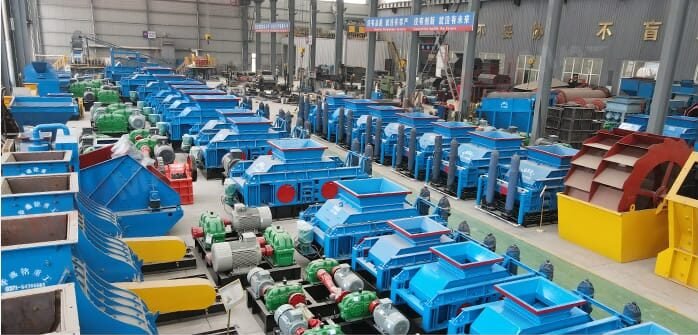
Q1: How long do the roller skins last? A: The service life depends on the material hardness and the roller’s alloy composition. At HSM, we use high-chromium manganese steel or tungsten carbide studs (HRC 58-62). For standard river pebbles, our rollers typically last 2,000 to 4,000 hours. We also offer customized wear-resistant coatings for extremely abrasive iron ore. Q2: Can the roller crusher handle wet or sticky materials? A: Yes! This is one of the biggest advantages of the double roller crusher. Unlike hammer mills or cone crushers, it has no screen at the bottom. It can effectively process materials with a moisture content of up to 30% without clogging, making it ideal for the rainy season. Q3: How do I adjust the discharge particle size? A: The particle size is controlled by the gap between the two rollers. On our Hydraulic Models, you can adjust this gap in seconds via the intelligent control panel or hydraulic pump. For Mechanical Models, it is adjusted by adding or removing shims behind the spring housing. Q4: What is the difference between a Double Roller and a Four Roller Crusher? A: Double Roller: Best for single-stage crushing where the reduction ratio is moderate…

Achieving peak performance from your granite sand making machine begins long before material reaches it. The key to optimization lies in superior feed preparation. Integrating a roller crusher as a dedicated secondary crushing stage is the most effective strategy. This machine pre-processes primary-crushed granite, transforming it into an ideal feedstock that allows your sand maker to operate at maximum efficiency. A roller crusher excels in this role by applying controlled compressive force. It breaks down the hard, abrasive granite into a more uniform, cubical product with a significantly reduced percentage of pre-existing fine dust. By feeding this optimized material to your sand making machine, you solve major performance constraints. The sand maker’s components experience less abrasive wear, its crushing chamber maintains better rock-on-rock action, and energy is used for final shaping rather than initial size reduction. This leads directly to higher sand output, improved product shape, and lower operating costs per ton, fully unlocking your sand making machine’s designed potential. Ready to maximize your granite sand plant’s return on investment? Contact us to learn how a roller crusher system can be your first step toward optimal performance.

As a key part of construction and mining, stone crushing is often seen as profitable. But with market fluctuations, strict regulations, and rising costs—Is it still profitable in 2025? Here’s a simplified analysis. Core Truth: Profit Exists, But Isn’t Guaranteed Strong demand from infrastructure and urban renewal supports the industry. The global crusher market is set to hit $49B by 2028 (CAGR 4.3%). US operations often have 20-35% EBITDA margins. Profitability varies by region and strategy. Oversupply in some markets cuts margins (e.g., 30% price drops in parts of China). Success depends on cost control, compliance, and demand capture. Key Profit Drivers 1. Market Demand & Pricing Booming infrastructure (India, SE Asia) boosts demand and prices. Oversupply (parts of China) causes price wars. US benefits from infrastructure bills; Europe from high waste recycling rates. 2. Cost Control (Make-or-Break) Major costs: – Equipment: Energy-efficient crushers (e.g., double roll) cut long-term costs. – Raw Materials/Mining Rights: Low-cost access boosts competitiveness. – Ops & Enviro: Dust/noise control is mandatory—poor management kills profits. 3. Policy & Compliance Non-compliance leads to fines/shutdowns. Green practices (e.g., waste recycling) may get subsidies, boosting profits. 2026 Profit-Boosting Tips Right Equipment: Choose energy-efficient, low-maintenance models (e.g., double roll) or…

The working principle of a roll crusher centers on controlled compression between two counter-rotating rolls, delivering several distinct operational benefits. As materials pass through the adjustable gap between the rolls, they undergo gradual size reduction rather than sudden impact, resulting in superior product quality and system efficiency. Operational Advantages Through Design: Controlled Compression – Gradual crushing minimizes fines production Adjustable Gap System – Precise control over final product size Even Wear Distribution – Prolongs equipment service life Energy Efficient Operation – Lower power consumption per ton processed Versatile Material Handling – Effective for both dry and slightly moist materials This efficient working mechanism makes roll crushers particularly valuable in mineral processing, aggregate production, and industrial applications where product consistency matters. Ready to optimize your crushing process? Contact Huashengming Heavy Industry in Zhengzhou to explore how our roll crushers can improve your operational efficiency and product quality.

When determining the best crusher for your concrete recycling operation, long-term operating costs and final product value are key. The Roller Crusher provides a compelling advantage through its efficient, low-wear design. Its compression-based crushing mechanism consumes less energy per ton than impact-based alternatives, directly reducing your power costs. Furthermore, the roller crusher’s ability to produce a consistent, in-spec product with fewer fines means more saleable material and less waste. With fewer high-speed wear parts compared to impact crushers, maintenance is simpler and less frequent, leading to lower downtime and reduced parts expenditure. For operations focused on turning concrete demolition into a profitable aggregate product, the roller crusher offers an optimal balance of performance and economy. Lower your cost per ton of recycled concrete. Discuss your project with Huashengming’s experts and discover how our Roller Crusher technology can enhance your bottom line.
A roller crusher achieves size reduction through mechanical compression between two counter-rotating cylinders, operating at controlled speeds typically ranging from 50 to 300 RPM. This method delivers distinct advantages over impact crushing, including lower energy consumption, reduced dust emissions, and more consistent particle shape. The adjustable gap mechanism allows operators to fine-tune output size with precision, while robust construction ensures durability in demanding environments. Key Technical Advantages: Adjustable Compression Settings – For exact product sizing control Minimal Fines Production – Optimizes yield and reduces waste Energy-Efficient Design – Lowers operational costs per ton Low Maintenance Requirements – Simplified design enhances reliability Interested in optimizing your crushing circuit? Connect with our technical team to discuss how a Huashengming roller crusher can be integrated into your specific operation for maximum efficiency and cost savings.
The unique properties of lithium ores, such as spodumene and lepidolite, demand a precise and selective crushing approach to preserve valuable mineral crystals and maximize recovery rates. Huashengming’s Roller Crusher is ideally suited for this task, serving as a key preparatory stage before further milling and beneficiation. Unlike impact crushers that generate excessive fines through violent fragmentation, the Roller Crusher employs a controlled compressive force. This method applies gradual pressure, promoting inter-particle crushing that naturally cleaves the ore along grain boundaries. This results in more uniform particles with minimized over-crushing, effectively liberating lithium-bearing minerals while reducing the generation of slimes that can hinder downstream flotation or chemical processing. It ensures the feed material for subsequent stages is optimally sized, protecting both equipment efficiency and final product yield. Optimize your lithium ore liberation process. Contact us to discuss integrating a Roller Crusher into your circuit.




 +86-13838144666
+86-13838144666
+86-13838144666


