



One of the most practical operational flexibilities of a double roll crusher is its ability to produce multiple sand sizing specifications on a single machine. By simply adjusting the inter-roll gap clearance, operators can switch between coarse, medium, and fine sand without changing internal screen plates, swapping hammers, or halting plant production. This article details how roll gap adjustment works, the sizing range covered, typical multi-product switching scenarios, and essential operational precautions from Huashengming (HSM) Heavy Industry.
Yes—and this represents one of the most practical operational flexibilities of a double roll crusher compared to other sand-making equipment. Finished sand particle size is governed entirely by the gap clearance between the two rolls: adjust the roll gap, and the product gradation changes accordingly. A single machine can produce coarse sand today, medium sand tomorrow, and fine sand the day after, without requiring screen plate replacements, hammer swaps, or time-consuming plant modifications 【Custom Parameters Available】.

HSM Hydraulic Double Roll Crusher Roll Gap Adjustment Mechanism
1. How Particle Size Is “Adjusted”
The “Crush-to-Size-and-Exit” Mechanical Logic:
- Roll Gap = Output Top Size: Material enters the nip zone, is compressed until it matches the inter-roll gap, and discharges immediately. Widening the roll gap yields coarser output; narrowing it produces finer sand.
- Mechanical & Hydraulic Adjustment: Gap modifications are executed via mechanical or hydraulic actuator systems—no teardowns, no machinery dismantling, and no parts replacement required.
- Particle Shape Remains Unaffected: Regardless of whether coarse or fine sand is produced, compression comminution consistently yields cubical, low-flakiness particles.
This distinguishes roll crushers from hammer mills (which require swapping internal grate bars) and vertical shaft impactors (which require rotor speed and crushing chamber adjustments). Roll crushers simply require opening or closing the discharge gap 【Custom Parameters Available】.
2. Sizing Range Covered by a Single Machine
A single double roll crusher can cover standard coarse, medium, and fine manufactured sand intervals, with the achievable range governed by model dimensions and material properties:
- Larger Roll Diameters Offer Wider Adjustable Ranges: Heavy-duty industrial hydraulic series machines cover broad reduction ratios from secondary-to-tertiary fine crushing down to sand production.
- Material Hardness Dictates Fine Limits: Softer materials like limestone and weathered coal achieve fine sizing more easily than abrasive, high-strength quartz or granite.
- Ultra-Fine Sand Requirements: When producing specialized fine sand (such as $0text{–}3text{mm}$ premium mortar sand), pairing the crusher with closed-circuit vibrating screens ensures superior stability compared to forcing roll gaps to extreme minimums.
3. Three Typical Multi-Product Switching Scenarios
- Scenario A: Serving Diverse Market Orders: Ready-mix concrete plants require medium sand, dry-mortar plants demand fine sand, and washing yards supply coarse concrete sand—a single machine adjusts its roll gap to fulfill varying customer orders on demand.
- Scenario B: Adapting to Quarry Face Variations: When raw pit materials change or feed gradations fluctuate, operators adjust the roll gap instantly to match new feed conditions without re-engineering the plant.
- Scenario C: Dual-Unit Parallel Gradation: Plants requiring simultaneous production of two distinct sand sizes deploy two double roll crushers in parallel, each preset to a specific roll gap. Their feeds and discharges remain independent, ensuring stable tonnages across both product grades.
4. Three Operational Precautions When Switching Sizes
- Throughput Fluctuates with Sizing: Narrowing the roll gap to produce fine sand reduces hourly volumetric throughput; widening the gap for coarse sand increases output. Expecting identical tonnage after tightening the gap is a common sizing misconception that must be accounted for during initial plant design.
- Incorporate Closed-Circuit Screening: Direct-discharge sizing exhibits wider grading variations than a combined crushing-and-screening circuit. For strict commercial concrete sand standards, integrating circular vibrating screens ensures consistent gradation curves.
- Maintain a Gap Setting Logbook: Record exact roll gap measurements corresponding to each product specification. When switching orders, operators adjust settings directly to recorded benchmarks, restoring production within minutes.
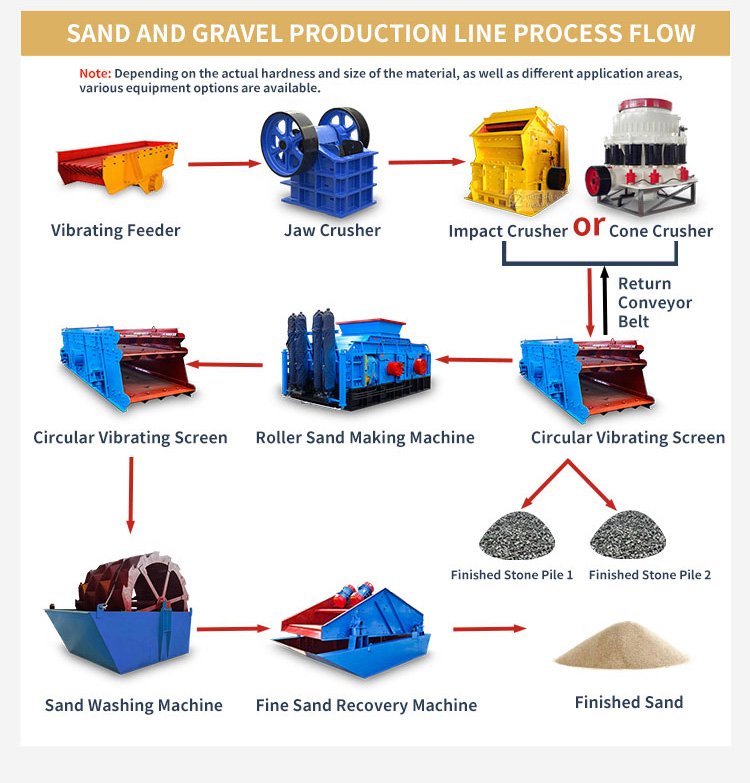
Sand Production Line Process
5. Frequently Asked Questions
Q: Can a single machine produce two sand sizes simultaneously?
A: No. A single machine features one unified roll gap at any given moment and can only discharge a single primary top size. To produce dual sizes simultaneously, plants utilize two parallel roll crushers or incorporate multi-deck classification screening.
Q: Does frequent switching between coarse and fine sand cause uneven roller shell wear?
A: Not at all. Roller wear is governed by cumulative tonnage processed and material abrasiveness rather than roll gap settings. Normal product switching has no adverse effect on shell lifespan 【Custom Parameters Available】.
Q: Can roll crushers produce ultra-fine $0\text{–}3\text{mm}$ premium sand?
A: Yes, double roll crushers can achieve fine gradations. However, meeting strict commercial fineness modulus and stone dust percentage requirements depends heavily on raw feed properties and target capacities. Send us your required specifications and we will confirm feasibility through formal engineering calculations 【Custom Parameters Available】.