


Double roll crushers and hammer crushers are widely used in crushing applications like mineral processing and construction waste recycling. However, their structural and working principle differences lead to distinct application scenarios and performance. Below is an overview of their key differences to guide equipment selection.
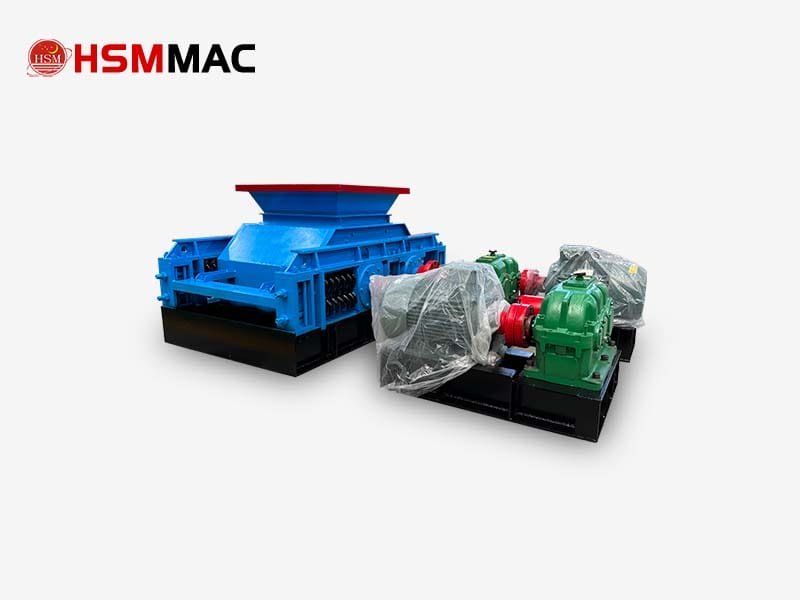
roller crusher
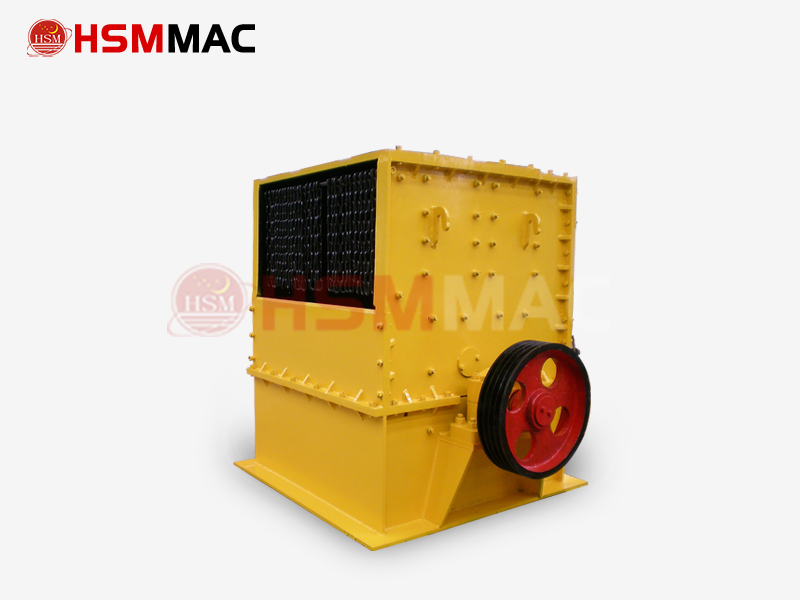
box hammer crusher
1. Working Principle: Compression Crushing vs Impact Crushing
The core difference between the two lies in their working principles, directly influencing their crushing methods and material adaptability.
Double roll crushers use compression crushing. Equipped with two parallel rotating rolls, they squeeze materials entering the roll gap until reaching the required size. The process is gentle, relying on static pressure.
Hammer crushers adopt impact crushing. A high-speed rotating rotor with hammer heads strikes incoming materials, breaking them into small pieces. Secondary crushing occurs via collisions with the chamber lining and other materials, with discharge through a bottom sieve plate.
2. Applicable Materials: Soft/Hardness and Brittleness/Ductility
Their crushing principles result in obvious differences in material adaptability.
Double roll crushers suitmedium-soft, ductile materials (e.g., coal, limestone, gypsum). They are unsuitable for hard brittle materials (causing roll wear/jamming) but excel with high-moisture materials (less adhesion/blockage).
Hammer crushers are ideal for medium-hard brittle materials (e.g., limestone, dolomite, shale). They perform poorly with ductile (e.g., metal scraps, causing rotor wrapping) or extremely hard materials (e.g., corundum, accelerating wear). High-moisture materials easily clog the sieve plate.
3. Crushing Ratio and Product Particle Size
Crushing ratio (raw vs. finished particle size) and product granularity are key performance indicators.
Double roll crushers have a small crushing ratio (4-8), producing uniform cubic particles. Finished size is easily adjusted via roll gap, suitable for medium-fine crushing requiring consistent granularity.
Hammer crushers feature a large crushing ratio (10-30), yielding finer particles (less uniform). Size adjustment is via sieve hole, suitable for primary/secondary fine crushing with high reduction demands.
4. Equipment Structure and Maintenance
The two differ significantly in structural complexity and maintenance requirements.
Double roll crushers have a simple structure with few wear parts (mainly roll surfaces). Maintenance is easy (surfacing/replacing rolls) with low costs, high reliability, and long service life.
Hammer crushers have a complex structure with multiple wear parts (hammer heads, liners, sieve plates). Hammer heads wear rapidly (frequent replacement), leading to heavy maintenance, high costs, and longer downtime.
5. Energy Consumption and Production Efficiency
Energy consumption and production efficiency are critical for industrial applications.
Double roll crushers havelower energy consumption due to compression crushing. However, their gentle mode limits production efficiency, suitable for small-medium lines with low output demands.
Hammer crushers have higher energy consumption from high-speed impact but offer higher production efficiency (large ratio, fast speed), suitable for large-scale lines with high output requirements.
Summary: How to Choose?
In summary, the two crushers differ in working principle, material adaptability, crushing ratio, structure, maintenance, energy consumption, and efficiency. Selection guidelines:
Choose double roll crusher for medium-soft materials, uniform particle requirements, low output needs, and cost/energy savings;
Choose hammer crusher for medium-hard brittle materials, large crushing ratio, fine particles, high output demands, and acceptable high maintenance/energy costs.
Practical selection should also consider raw material characteristics, product requirements, production scale, and budget to maximize equipment performance and economic benefits.